
Melody Makes All the Difference
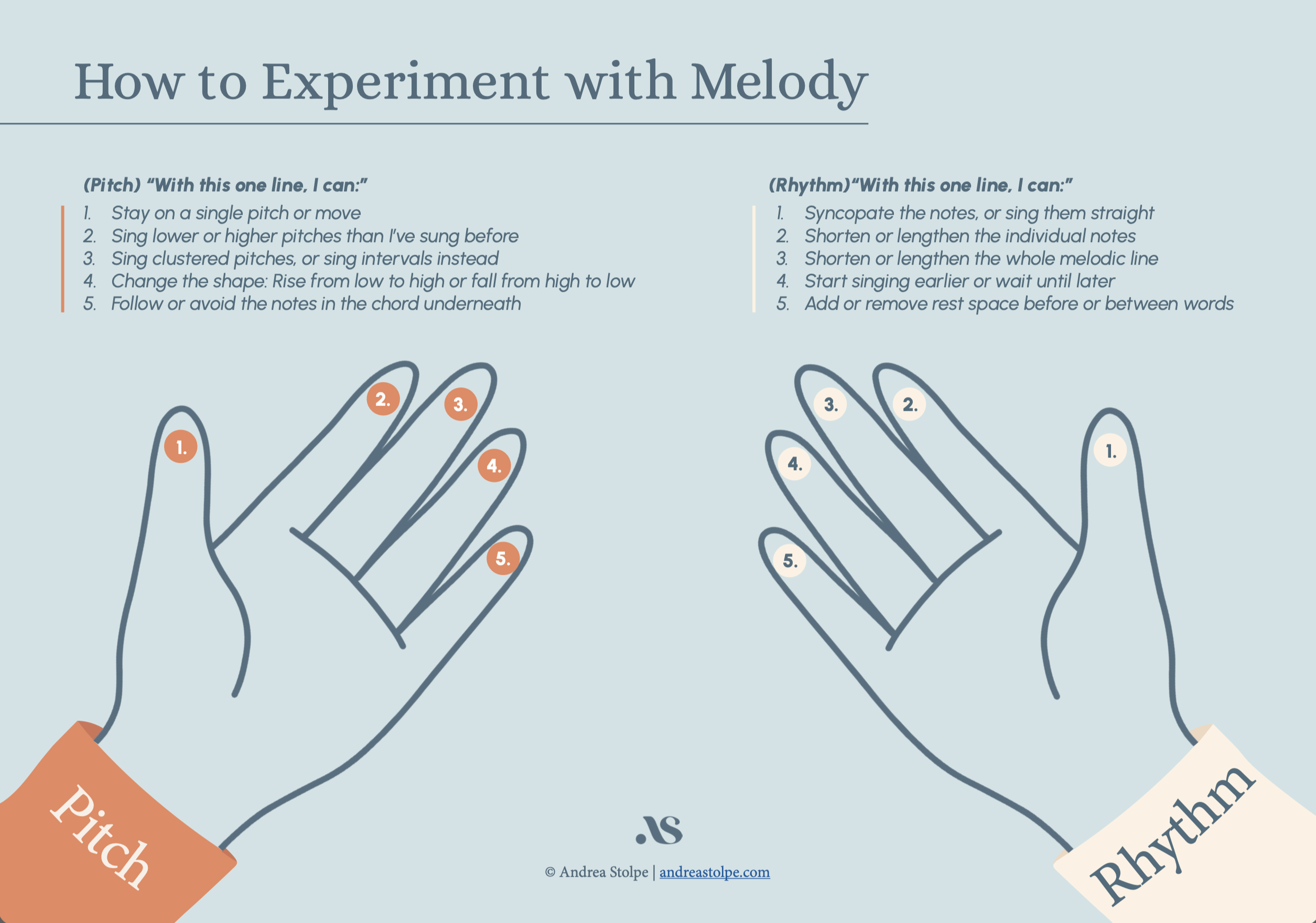
This article includes an accompanying PDF guide, “How to Experiment with Melody”. Keep reading for the free link to download.

We songwriters often assume that if a song isn’t landing emotionally, the problem must be the lyric. We spend hours revising, tightening phrases, searching for stronger rhymes, and scratching entire sections only to try accommodating them again in a later version. But sometimes there comes a point where no changes seem to actually improve the song. This is our signal that we might be tweaking the wrong element, and the lyric isn’t the problem. We might be asking lyrics to do a job that actually belongs to the melody.
Thoughtful writers tend to focus heavily on lyrics. In many ways this makes sense. Words are visible, concrete, and easy to revise. We can look at a line and quickly decide whether it needs improvement.
But melody doesn’t work the same way. It’s harder to analyze and measure, and more difficult to adjust once we’ve settled into a melodic rhythm. Because of this, many writers return to their lyric page when something in the song feels flat. We assume the emotion isn’t coming through clearly enough in the words.
The reality is that melody and lyric are not separate elements of a song, but work together to create the emotion the listener feels. They are two parts of one whole, affecting one another, though they don’t do the same job. A helpful way to think about it is this:
Melody creates the emotional field.
Lyrics focus the meaning inside it.
In other words, the melody establishes how something feels, while the lyric clarifies what the feeling is about. Or another way to say it is the melody creates the size and shape of the container, while the lyric fills it. The lyric can’t carry meaning beyond what the container allows. This is why tweaking a lyric over and over again results in the same lack of effect.
I'll dive into this idea, and helpful melodic tools, below. But if you'd like an easy-sheet to refer to while you're writing, I've created this PDF with 10 tips to reference while experimenting with melody. You can click here to download it for free: “How to Experiment with Melody”
Two Important Positions for Emotional Weight
We don’t have to write a magically inspired melody to accompany every word in our song for the song to land. There are two moments in almost every section of a song where melody plays a particularly important role in sharing the lyric’s true emotion:
The first is the opening line of the section. This line establishes the melodic theme that listeners will come to recognize and expect that defines ‘this’ song and distinguishes it from ‘other’ songs. It introduces the rhythmic and pitch patterns that shape the musical identity of the section.
The second important moment comes when a line breaks away from that melodic theme. Once listeners recognize a pattern, changing it creates tension and attention. That change is an opportunity to highlight something emotionally significant in the lyric.
Any song with structure uses this technique of setting a melodic theme and then breaking it.
Consider the chorus of the song ‘Walking on Sunshine.’ The first three lines repeat the title itself over the exact same melodic theme. Go ahead, sing it to yourself:
I’m walking on sunshine….whoa
I’m walking on sunshine….whoa
I’m walking on sunshine…whoa
Now, imagine singing the last line of lyric ‘And don’t it feel good’ over the same melody. No matter what we say there, it lacks the ability to feel like the capstone, or the final destination. I could change the lyric over and over, and it still wouldn’t have the power to land. Now, we’ll never feel a landing by remaining on a dominant chord function as the earlier three lines did. So we can experiment with that thought by cadencing in the chord progression, just as the original chorus does, while keeping the melody the same as the first three lines. It still lacks power, even though the melody does indeed agree with the IV - V - I progression we’d play underneath.
The melody must break the pattern of the first three lines to show the new 4th line of lyric to be something special. The lyric can’t do it alone, but must have the power of melody to complete its message and emotional delivery.

So how do we control melody to make sure we’re using it to color our lyrics? At its core, melody communicates emotion through two elements: pitch and rhythm. Pitch determines which notes we sing. Rhythm determines when we sing them and how long they last.
Within those two elements we have many expressive options. A melody might:
land squarely on chord tones, or lean into tension against them
move stepwise through small intervals, or leap across wider ones
use short rhythmic bursts, or stretch into longer sustained notes
begin behind the beat, or anticipate the downbeat
Each of these choices subtly changes how the lyric feels to the listener.
When pitch and rhythm reflect the emotional meaning of the lyric, the song suddenly feels aligned. Take out an old song of yours that’s stalled, and see if you can identify what is going on with melody in only the first and last lines of each section you’ve written. Ask yourself if you’ve clearly established a melodic theme in line one that has the chance to repeat throughout the section, and broken away from that theme in the last line of the section. Then, experiment with small changes in pitch, rhythm, or note length. Notice how those adjustments affect the emotional meaning of the lyric.
Often, our song doesn’t need new words. It simply needs a melody that allows the lyric to fully land. When melody and lyric support each other, the message becomes much more powerful than either element alone.
I dive into these melodic tools and more within my course The 30-Day Songwriter. Created to help writers develop a consistent daily practice, this month-long course shares the melodic, lyric, and harmonic tools every songwriter should have in their tool-belt.
Stay creative,
Andrea