
4 Questions to Find Your Song

Inspiration is generous, but it certainly isn't tidy. In my house, it hands me a feeling, a phrase, a fragment of melody, a mood I can't quite name and then it walks off with me standing there holding something important that lacks shape. My instinct is to push harder, to demand that the idea reveal itself. But pushing rarely works on something this half-formed.
When I find myself sitting in the gap between pieces and a full song, a key to getting things moving again is ‘narrowing.’ We can do this gently and intentionally, with one question at a time, until the song has somewhere to stand that we can actually name.
There are four questions I’d like to share with you that I keep coming back to, in the order I’ll present them here in this article. They don’t need to be answered all at once. The important thing is just to start where we already feel like we have answers, commit to them, and let the rest follow.
1. How does the song feel?
Not what it's about, but how it feels. Those are different questions, and the second one almost always comes first in good songs.
I find it useful to picture a simple map with two axis: energy and pleasantness. That gives us four territories.
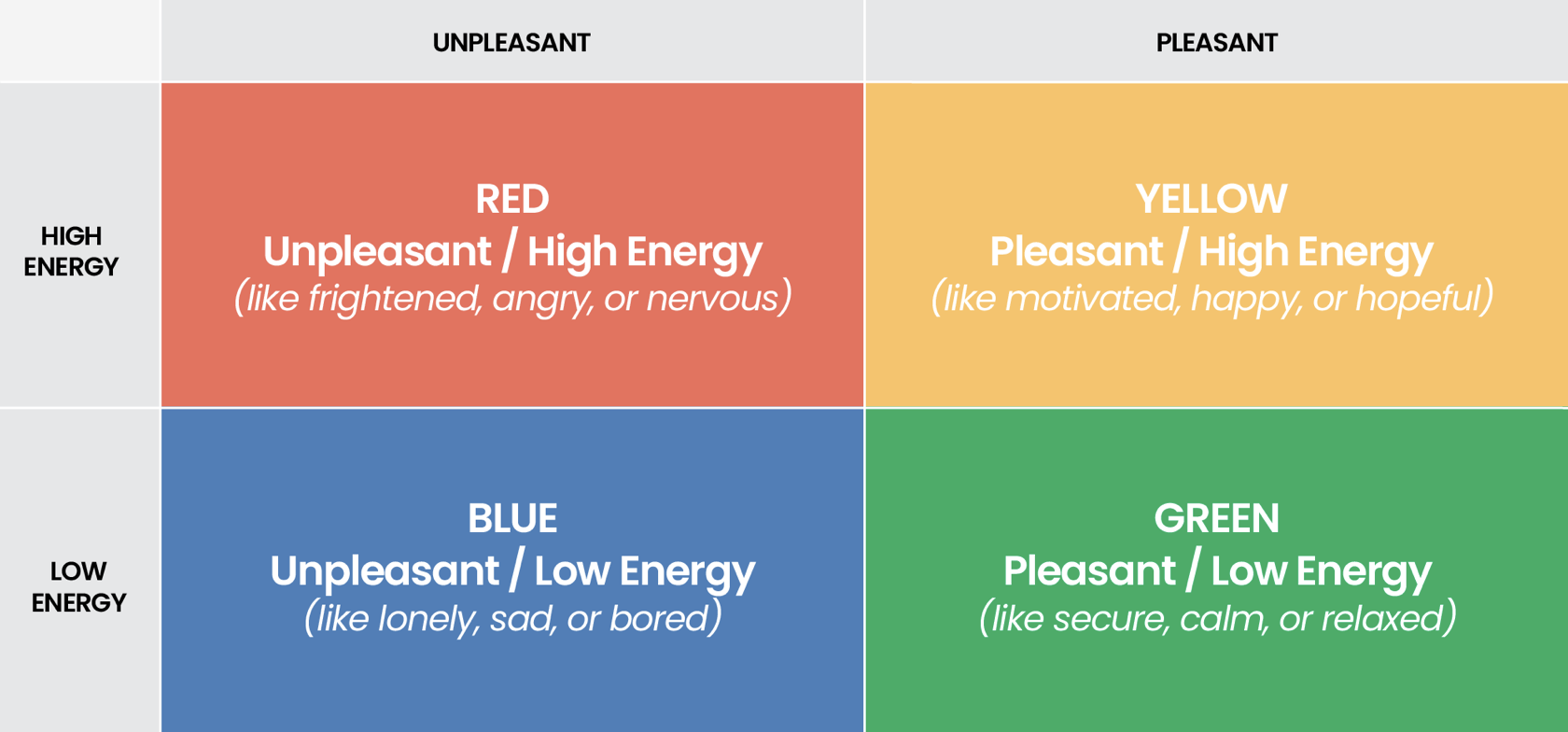
High energy and unpleasant (red) is the angry, agitated, scared corner. Low energy and unpleasant (blue) is sad, tired, heavy. High energy and pleasant (yellow) is bold, brave, joyful, pumped. Low energy and pleasant (green) is calm, peaceful, content.
Most songs we love sit pretty squarely in one of those quadrants, and once you can locate the quadrant for the song you’re working on, a surprising number of musical decisions start making themselves.
The quadrant becomes your tempo, your groove, the harmonic flavor underneath. A song that lives in the calm quadrant just doesn't sound like a song that lives in the brave one. So before you write a single line, pick the quadrant your concept is asking for, and commit.
2. Where is the singer standing in the story?
Once you know how the song feels, the next narrowing is positional. Where, exactly, is the singer standing in relation to the thing that's happening?
There are three places to stand, and each one is a different song. Before the moment is anticipation; wishing, dreading, hoping, or bracing. The thing hasn't happened yet. In the moment is urgent and immediate; we're inside the experience as it's unfolding. Beyond the moment is reflection, because it’s already happened and the singer is looking back, making meaning of it.
Three completely different songs, each created by where the singer is along the timeline of the story. Pick a dot on that timeline and put your singer there.
3. Why is the singer telling us this today?
This is the question that gives you a song. Why now? Why this moment and not yesterday, or next week when the singer might have more information?
The answer almost always lives in contrast, and what I sometimes call the “rub.” It’s the “then” and the “now.” It’s the way it used to be against the way it is. It’s what I believed against what I now know. It’s what I want against what I have. These two perspectives, held up next to each other with the friction between them, powers the song.
Once you can name the rub, you've quietly chosen a tense, too. Past against present, or present against an imagined future. And that's usually the moment the song starts to reveal itself, too, not because you've forced it, but because you've narrowed enough that it has room to step forward.
4. Whose voice is telling it?
Before you commit to a final direction, give yourself permission to try the song on in different points of view:
What does it sound like in first person, using I?
In second person sung directly to someone, I and you?
In the universal you, the kind of you that means anyone?
Or in third person, where the singer is outside the situation, telling a story about other people?
Shifting the point of view isn’t a massive rewrite, either. All you need to do is exchange the pronouns, just to get a feel for how the new song would sing. You don't have to keep what you find, but trying on two or three different points of view almost always reveals something your first instinct missed. Sometimes the song you actually want to write is hiding one point of view away from the one you started with.
That's the path: Emotion, lyric state, the rub, and the point of view. Four questions in that order, starting wherever you already feel like you have an answer.
The work here isn't to know everything before you begin. The work is to keep narrowing until the song has somewhere to stand that you can name. Inspiration hands us the shapeless thing on purpose. Our job is to give it edges.
If this is the kind of work that lights you up, I'd love to have you join me at a songwriting retreat. We spend five days going deep into the musical and lyrical questions just like these, taking the concepts you've been carrying around, sometimes for years, and shaping them into songs.
Stay creative,
